Everything
Attention is an Obligation

This is the final essay in a series of 4 on the subject of attention. I hope you enjoy reading it as much as I have writing it. If you are interested, the other three:
Where We Live - About seeing a place
Bruton - About seeing people
The Watch - About time
Enjoy this latest essay!
The shorebirds are usually active at dusk. The curlew and godwit poke and retreat. The godwit watch each other, stitching the sand seeking crabs. They barely notice the curlew. The godwits share a world, godwit-shaped, similar but different to one the curlew would recognize. Attention in the natural world is “as much as necessary,” local and close.
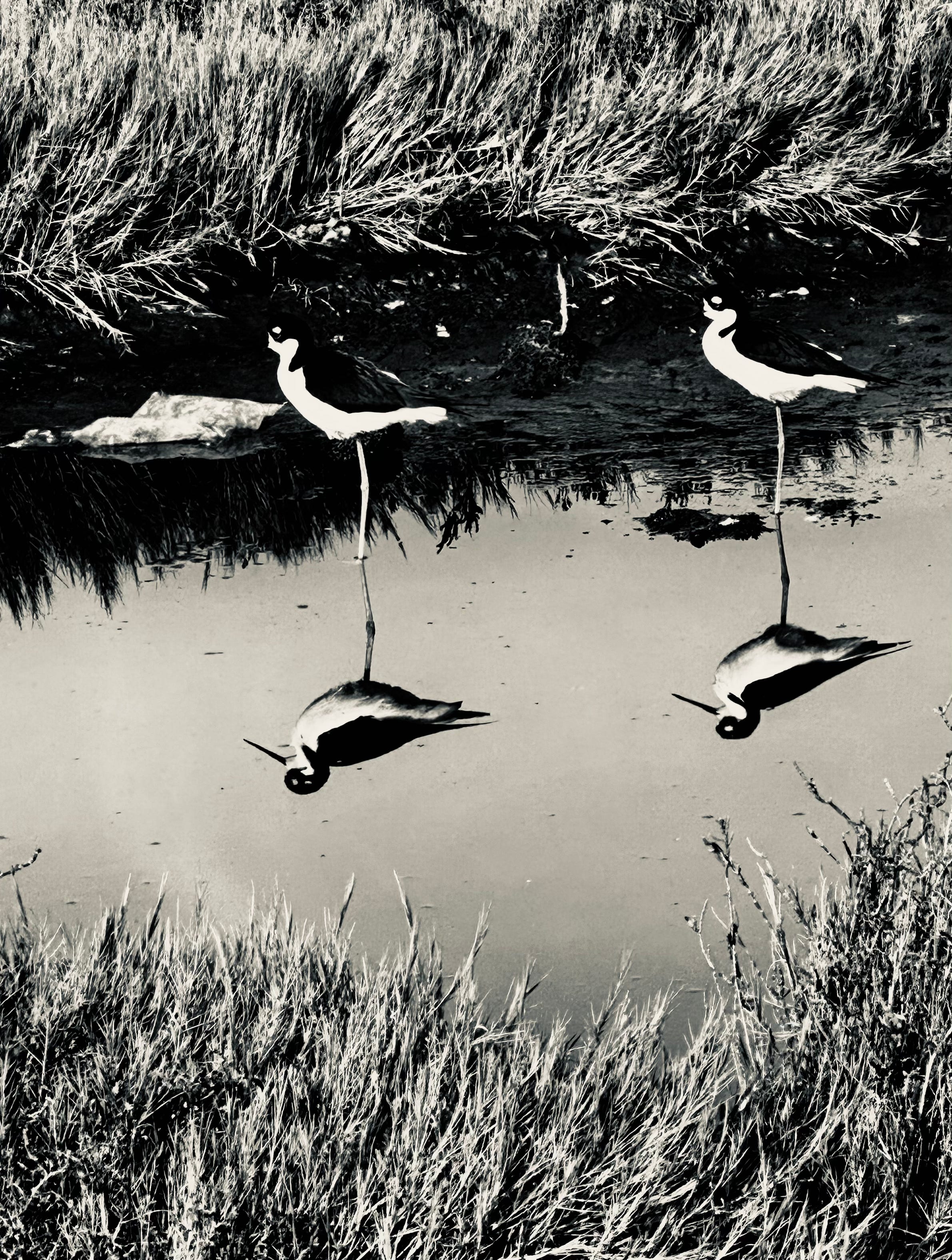
A littoral1 scene is the nervous separation of like things: bird from bird, swell from sand. The pelicans will arrive with the herring, then leave. The sand accommodates the waves. Back and forth is grace enough.
Everything here yields to everything else “just enough.” Adequate attention.
A cancerous cell is malign because it no longer listens. Inattentive to its surroundings, it can only consider itself.2 Everything alive is a conversation at a boundary, its absence the loneliness of infinite appetite.
The heron devours the frog, but no heron attempts to devour frogness. The heron is still when sated. It does not justify the strike because it never goes beyond what is apparent. Hunger is a finite boundary.
We are a species of relentless appetite that abstracts to consume, because noticing might entail stopping. A school of dead children is unseeable. A friend shrugs it off, saying “Hamas” as though it were a shield hex against judgment.3 No other predator imagines themselves a liberator.
I am struggling to be an ethical person without ruining my sleep score. I think ethics and attention might be the same.
Everything that matters is I, me, mine. “Just For You” is just for me. I am exquisitely groomed to ignore. The daily muster required to defend this selfishness should have been a clue. Am I alive? Let me check my steps. The urge to be separate is so powerful, as though isolation were ascension.
Perhaps I should stop. Allow my self to drift like the foam crust of the tide’s retreat. Sometimes I try to count how many waves I can see at once, but they keep dissolving and returning. They mock my intensity. I want God to be impressed by my determination. He is patient.
The plunge of the cormorant is an essay in negotiation. The cormorant’s feathers are not quite waterproof, and the terms of its deeper dive are a bit of saturation. The sea accepts.
I negotiate like a seabird, at the edge. Can I let everything in? I often resist, though I suspect my rigidity is just holding me in suspension. When I float in the ocean, there is loudness and peace, an agreement honored with indifference. As I breathe, I sink or float. I live through contact: the chill of submersion, a friend’s grieving, and the landlord. I want to be safe. An animal’s organs are membranes within membranes, its self a conditional truce. It is the same inside me. I am the place where the world and I press on each other for a bit.
I have had moments of deep attention, where the tiny feathers of a tern are clear at an implausible distance. I won’t look away: “Bravo, nice work on the wings,” pure grace. We are both silent in the landscape, neither close nor distant. I cannot know how the tern sees me, only that it does, a partial encounter each in its own mode. I will remember.
The seashore does not lay a place setting for the tiger. He never shows. Most of nature sits down with regular guests and timeworn stories. We are the uninvited guests who demand the head of the table. We are present everywhere, local and foreign, in every encounter.
The sea does not abstract. It has traveled, and it knows the older violences that scour the land, and it will outlast them. I cannot bear the image of a tiny backpack nestled in the rubble; it is too particular, a grain of sand that fixes my attention. I am there, touching, but not necessarily understanding. What do I know about her life? What do I owe her?
I struggle because the owner of the backpack is familiar and unfamiliar. A child’s name in Arabic script. Terrorist. Muslim. Other. Jetties built long ago that protect us from the swell. She is so far away that it could be the gentle caress of the sun, a sense of safety without the cost of seeing. But the swell pounds the rocks, and the backpack indicts us, demanding our account.
Look. Look. Look.
The curlew and I offer just enough attention to each other. The tide demands more. It is beautiful and deadly, and abstraction exhausts itself in the undertow. I am here counting tides, a patch of skin where sea and air and fear meet. For now, I watch it engulf my feet.
What we owe is attention, a duty to keep the real from becoming unreal.
Littoral: “Relating to or situated on the shore of the sea or a lake.”
“In addition to inducing and sustaining positively acting growth-stimulatory signals, cancer cells must also circumvent powerful programs that negatively regulate cell proliferation; many of these programs depend on the decisions of tumor suppressor genes.” — Hanahan & Weinberg (2011)
Psychologist Sam Keen's work, and later research by Daniel Bar-Tal on "delegitimization," documents how state-level propaganda systematically deploys category labels (vermin, cockroaches in Rwandan radio broadcasts, "animals" used by various governments) to license violence by short-circuiting individual moral evaluation.
Of the 4 essays this one hummed strongest for me. All 4 were a lovely use of my time. Thank you for choosing to share your writing.
All 4 pieces made me quiet and thoughtful. I found myself in a meditative state. Certain phrases were extraordinarily beautiful “the place is meant to be consumed - time is in its pores”. “A prior me, a prior we”. I probably didn’t get these exactly right but the pieces were laden with these beautiful phrases. In any event, all of the works had me deep in thought about the words, phrases and life. Found myself deeply present.